So, last week's post about giant centipedes got me to thinking about what happens when you cut off those 100 legs. You end up with a worm. And as if it's those legs that make them, for whatever reason, not compelling monsters for stories, I guess that would explain why when you think about giant worms, there's all SORTS of stories and movies out there! It's certainly easier to do a giant worm in a movie; they're easy to build, after all!
And I'll get it out of the way right here. Although I do like the sandworms from Dune... I'm not gonna say anything more about them here, because overall, I really don't care for Dune.
So.
Giant Worms are even in the same movie I mentioned last week—Peter Jackson's remake of King Kong. And elsewhere as well. Heck... I guess I don't have much more to say about giant worms, but the list below is pretty big nonetheless...
The concept of humans with animal heads is one of the classic monster tropes. Want a quick and easy way to make a person scary and strange? Give them a wolf head or a tiger head or a snake head. Or, as it turns out, an owl head.
The Owlman isn't a monster I'd heard much about until earlier this year, when a Kickstarter project caught my attention—a movie called Lord of Tears was seeking some money to secure some additional funding for last minute additions and reshoots, but primarily so they could pay for distribution of the already pretty-much-complete movie. After seeing Absentia come to life thanks to Kickstarter, I'd been keeping an eye out for other interesting and promising horror movies to help fund, so I probably would have kicked in some cash for Lord of Tears even if the movie hadn't yet started filming.
Now, while the Owlman of the movie was a very specific monster with a very specific tie to history, the "real" Owlman is a figure that haunts the area around Mawnan, Cornwall. He hasn't been sighted all that often, which may be why I've not heard about him in my relatively extensive monster researching lore. Variously explained as a manifestation of energy from prehistoric ley lines to sightings of rare eagles or other birds, I think my favorite explanation remains that he's a sinister demigod from antiquity. Which is, as you'll see in my next post, what the movie went with!
As a kid, I used to have night terrors. These aren't just nightmares. These are visions of such unrelenting horror as you sleep that you simply can't do anything but shriek and scream. I can hardly imagine what it's like for a parent to have to deal with a child who has night terrors. I get them still now and then today, particularly when I'm overstressed... the best way to handle them is to get up, walk around, grab some water, and take 10 minutes or so to reinforce the fact that you're fine, you're in your home, you're safe.
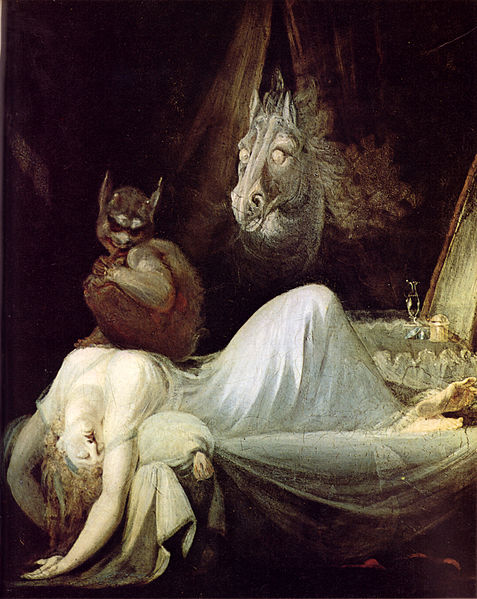
Night terrors have tormented us as a race from the START of the race. But they aren't the most frightening form of nightmare to me. The most frightening would probably be what's called "sleep paralysis." I've never suffered from this type of nightmare, but plenty of people have... it's the type of dream where you wake up, hallucinate, and simply can't move... and all that comes with an overwhelming feeling of terror and dread. It's from experiences like these that all manner of notorious legends and myths have evolved, from the succubus and incubus on up to the more contemporary aliens who supposedly abduct folks to perform experiments.
One such creature in this category is the alp—a creature from German mythology similar in some ways to a vampire, in others to a ghost, and in still more to an incubus (although the legends generally don't include a sexual element in the alp's case).
Yet, if I've never had sleep paralysis before... why am I suddenly all intrigued by alps? Well, I just finished playing a VERY good video game earlier today—a tense and stressful thing called Outlast. In the game, you play a reporter who gets a tip that there are strange goings on at an old asylum, and so you head up there one night to investigate, armed only with your video camera. This camera is also your only way to navigate the darkest parts of the asylum, by letting you use the night-vision mode to do so. Of course... there are ALL SORTS of horrific things going on in the asylum for you to run from and hide from; crazy people, deranged doctors, naked deranged orderlies, deformed lunatics, mutants... and as the game progresses, something called a "walrider." Which is, of course, another name for the alp.
The game's a piece of work. Made me jump back from the computer several times. Highly recommended. Just don't play it late at night, especially if you're prone to the terrors! Check out the gameplay footage/trailer below... IF YOU DARE!
The majority of my early childhood exposure to monsters and horror came at my grandparents house. Both my grandfather and grandmother on my father's side were prodigious readers. My grandpa had several stacks of horror comics, like "House of Mystery" and "Tales of the Unexpected," while my grandmother kept me well supplied with reading material—she gave me Cujo to read at the ripe age of about 9 or 10, and a year or two later gave me some Clive Barker books. It was in my grandparent's reading room that I first discovered F. Paul Wilson, Dean Koontz, and many others.
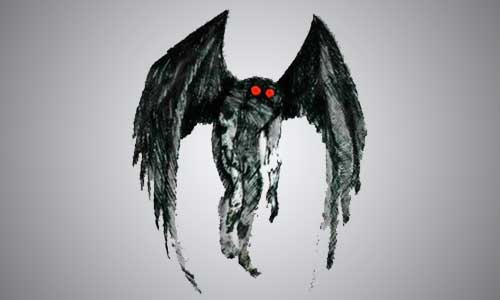
Including mothman.
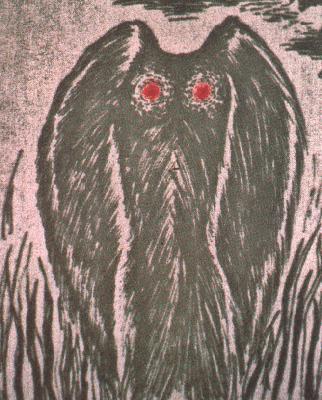
The book was The Mothman Prophecies, by John A. Keel. The copy I found in my grandma's collection had what looked like a photo of a scary flying red-eyed monster on the cover, and proclaimed in bold red letters: "COMPELLING AND GENUINELY FRIGHTENING!" How could I resist that?
Turns out, those letters are right.
The Mothman Prophecies doesn't read like a horror novel; it's presented as a collection of case studies and interviews and investigations performed by John A. Keel, exploring the mysterious sightings of a red-eyed monster that was haunting the region around Point Pleasant, West Virginia. The book went on to link Mothman to shadowy government conspiracies, the men in black, UFOs, and of course the collapse of the Silver Bridge.
When X-files finally came along, it already felt familiar to me as a result, because this book was very much a proto-X-files. And mothman's been creeping around in the back of my mind for the past 30 years or so as well.
I know, I know... Parasites are monsters already. Want proof? Go google images of bot flies, guinea worms, warbles, and... actually, don't google those at all. Trust me. You don't want to see that stuff.
This post isn't about real-world parasites. Those are too frightening. This post is about monster parasites from film and fiction. These critters are horrifying and disgusting and vile, but when the movie is over and the book is done, you can breathe easy, knowing it was all fiction. Right?
In fact, now that I think on it, my two favorite movies are about parasites. In Alien, you've got a creature that has a complex five or six stage life cycle that uses another living creature as a host to transition from its second and third parasitic stages into its fourth and most violent stage. And in John Carpenter's The Thing you have a creature who's every single cell is its own creature, a parasite that invades any living thing, feeds on it, and then becomes it.
Hmm. This is kinda suddenly exploding into a huge new category, the more I think about it. I mean... there were the freaky insectoid lice creatures that infested the body of the monster in Cloverfield, the supernatural demonic entity of the Rec movies, the slithery worms in Slither and the creepy worms in Night of the Creeps, the critter from Wrath of Khan, and of course the eponymous parasite of the movie Parasite (AKA Demi Moore's first movie). Which, as you can see below, has an incredibly awesome trailer.
At least it's not a guinea worm!
Actually... I'm gonna stop here and just start the reccomended viewing and reading lists. There's a lot. I'm sure I'll forget some. But the following should keep you squirming for a while.
Sometimes, monsters are scary because they have a horrific shape. Spider faces, demonic visages, twisted bodies, mutant limbs, and more are classic monster parts. But sometimes, the scariest monster is the one without a shape at all. I'm not sure if it was a broadcast of "The Blob" on Creature Features or merely the discovery of amoebas in a science book that introduced me first to the idea that monsters without shapes at all could be plenty scary. Come to think of it... it was probably my dad who introduced me to the concept.
As a kid, I'd take a sheet of paper, then draw a line down the middle and then three lines across, dividing the sheet into eight smaller squares. I'd then bring the sheet of squares to my dad and ask him to draw me 8 monsters in the squares. He never failed to dream up great monsters, but now and then he'd draw a blob. He'd explain how it works—it grabs you and eats you alive, basically—and in hindsight I can't help but wonder if he chose blobs now and then because they were an easy monster to draw when your kid's asking you to draw 8 of them. I remember in particular a giant sea amoeba creeping up on a guy who was bent over a tidepool rock reaching for an abalone... even as the man reached, the blob was reaching for HIM.
"The Blob" is, of course the movie most folks think about when you mention shapeless slime monsters, but as fun as that movie is... it's not the best of its kind. The remake was surprisingly good (and just as surprisingly, a horror movie that came to the Point Arena theater), bu there's also movies like "X the Unknown" and "The Quatermass Xperiment" that feature some pretty creepy shapeless horrors. Interesting how both those two have the letter "X" in their names!
In literature, of course, blobs are all over the place, particularly in Lovecraft's writings. Shoggoths, after all, are the quintessential blobs—workhorses invented by an alien race who managed to become intelligent and rebel against their one-time masters. Hopefully Guillarmo del Toro will be able to get his version of "At the Mountains of Madness" on film some day and we'll have one more blob to ogle!
There's lots of stories and movies out there about giant arthropods. Particularly if they're giant spiders, but other creepy crawlies like scorpions, ants, and mantids all get their fair attention as well. Including crabs! When I started this post, I had assumed that there was only a few examples of giant crabs in fiction. I wondered why. Was it because they're just not as widespread? Because you kind of have to grow up on a coastline where there's beaches to visit to have a healthy respect and fear for these creatures? Certainly crabs exhibit plenty of creepy traits that should make them as feared as spiders—they have long legs... they can pinch hard... they move weirdly... and they have creepy eyes. But then, as I started thinking and researching, I realized how wrong I was!
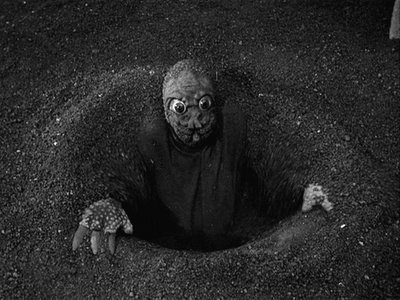
I remember once, as a teen, I was down at Point Arena cove with my dad, getting some quality abalone picking in. I came to a tide pool filled with sand, and on a lark I decided to dig into the sand with my hands. I dug for a few seconds, made a hole, then straightened up to watch it fill in with water. In that instant, a kelp crab reared up out of the sand precisely where my fingers had been a moment before. For those who don't know what a kelp crab looks like... check out the picture. My memory says the thing was about a foot across... it was probably closer to six or eight inches across. Regardless, I missed having my finger snatched by a spiky brown alien monster by only a few seconds. I never dug in a sandy tide pool again.
"I HUNGER FOR HUMAN FINGERS!"
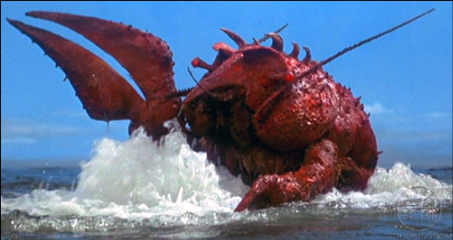
Giant crabs and their kind show up relatively often in fiction, if you know where to look. There's Ebirah, one of the various kaiju that co-stars now and then with Godzilla, although Ebirah's more properly qualified as a giant lobster. There's also the giant crab that menaces the cast of The Mysterious Island. That crab's got the distinction of being an actual crab shell that was then articulated and animated by Ray Harryhausen, and as you can see in the clip at the bottom of this post... it looks pretty awesome, even half a century later! And then there's The Lost Continent, which is about a ship full of sweaty dynamite, man-eating seaweed, the descendants of the Spanish Inquisition stranded on said lost continent, and a fight between a giant crab and a scorpion.
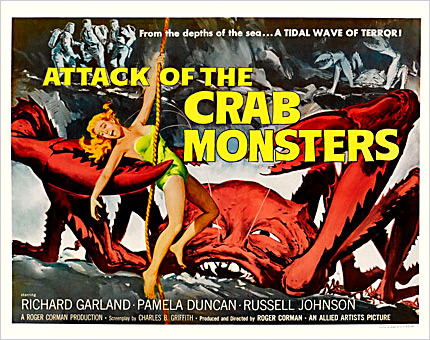
Of course, no giant crab post is complete without mentioning the Casablanca of giant crab movies (ha! I like doing that)—Roger Corman's Attack of the Crab Monsters. In typical Corman style, this is a low-budget movie with a high-budget plot. Not only are the crabs in this movie giant, but they're intelligent too, because they absorb the intellect of those they eat. But it doesn't stop there! They're also psychic, and can mimic human voices by telekinetically vibrating metal objects at precise amplitudes to speak to their victims. Who are stranded on an island. Oh, and the crabs are using their telekinesis to slowly sink the entire island into the ocean. Oh... and these giant mutant crabs are almost impossible to hurt due to their regenerative powers. And perhaps worst of all... the crabs know that they're better than humans, and not only try to kill them and eat their brains to absorb their knowledge... they mock and threaten humans while they do it! This movie is nearly perfect!
There's also a series of books (SEVEN!) by a man named Guy N. Smith that features crabs. He's also written a few short stories about his favorite critter, and it's one of those that I've read—I've not yet read his novels. Come to think of it... I should do so. Huh... looks like the first of those books became a movie called Island Claws. Unseen by me—and indeed, never even heard of by me before this post. Island Claws isn't out on DVD or Blu-ray or on Netflix... but as is the case with such obscure old movies, it DOES appear to be on You Tube, and the first of the crab books he wrote is available on the Kindle... The movie (which I just watched a little bit of) looks disco-riffic—not a quality I associate with giant crabs, but skipping ahead, the giant crab itself looks not bad for a 3-decade-old movie. I can't yet put any of his books down as recommended reading, since I haven't read any yet...
Perhaps I jumped the gun on this giant crab post. Obviously, I need to educate myself more on the genre!
Last week, we took a look at humanoids from the deep. This week, we're doing the exact same, only the deep in question this time around isn't the murky waters where all manner of slimy and scaly monsters lurk. This time, the deep is right below your feet, in the sewers below! Well, assuming you live in a city. If you're in a rural area, count yourself luck that you don't have to worry about mole people!
There's rumors they're real, of course. Entire societies of people living down below, dwelling in tribes below the city streets. Of course, if those rumors are true, they're still people. What I'm talking about here are those who've undergone transformations from human to monster.
Of course, the "Casablanca" of mole people movies is C. H. U. D. I'm pretty sure that's the first time anyone's ever compared those two movies, too. C. H. U. D., as most folks know, stands for Cannibalistic Humanoid Underground Dwellers. And those of you who've seen the movie know it also stands for Chemical Hazard Urban Disposal. That acronym, although it's less cool, is more accurate, especially since the chuds in the movie aren't strictly cannibals; they don't eat each other, just humans. But who am I to argue with the brilliance of C. H. U. D?
On a more serious note, while there's certainly a giant dose of campy fun in the movie, there's also some pretty spooky stuff in C. H. U. D. Similar to how zombie movies present us with our own selves, transformed into deformed monsters that want to eat us, the chuds are, after all, us. With a heavy dose of mutation-causing chemicals, of course.
One of the top three things I'd rather not see on a city street at night...
But if C. H. U. D. is too corny for you... then there's always the Japanese movie Marebito. It's as much a vampire movie as a mole person movie, but it's also not corny at all. Very spooky, and with some Lovecraft stuff as well!
Over on the reading side of things, there's the obvious mole person story, "The Time Machine." There's also Clive Barker's Midnight Meat Train, which made for a rather good (if very gory) movie in my opinion.
But my hands down favorite? T. E. D. Klein's short story "Children of the Kingdom," which combines some creepy mole men shenanigans with a blackout in New York City. Klein's actually one of my favorite authors, even though he's only ever written a handful of short stories and one novel. They're all brilliant, though. Hmm... it's also been way too long since I've read those stories. Might need to fix that tonight!
Hmmm... Just realized. C. H. U. D., Midnight Meat Train, and Children of the Kingdom all take place in New York city. Maybe there's something to those urban legends after all?
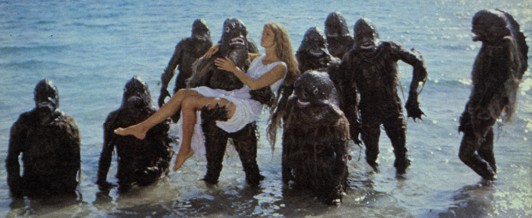
There's something creepy about fish. Sure, they're delicious, but look at their faces! Those big staring eyes... the gasping mouth filled with teeth... the scales... yeah, they're creepy. So it's no big surprise that there's been quite a lot of horror stories about fish people over the years. I've grown up with fish all around me—my father's a retired commercial salmon fisherman, after all, and in those years I've seen plenty of the strangest and scariest fish the Pacific has to offer. Sharks, eels, lingcods, cabazones, eels, hagfish (puke!), sunfish, flounders... the list goes on. All of them are creepy in their own way
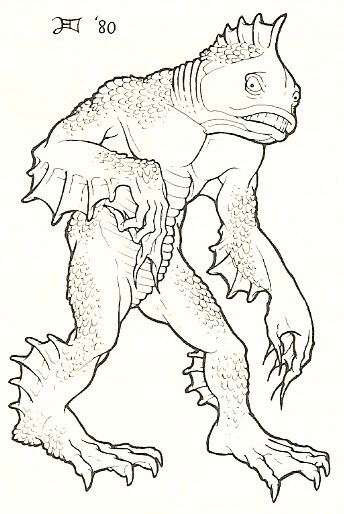
Of course, it's to H. P. Lovecraft that we must go to for the classic story about fish people. The concept of icthyic humanoids appears numerous times in his stories, but never to the extent of the deep ones in one of his best tales, "The Shadow over Innsmouth." Since then, there's been a LOT of entries in the genre... some great, like "Creature from he Black Lagoon," some fun but not so great, like "Humanoids from the Deep," (a movie that was filmed in the town of Noyo, about 45 minutes north of where I grew up), and some that are just plain awful.
Like "Screamers."
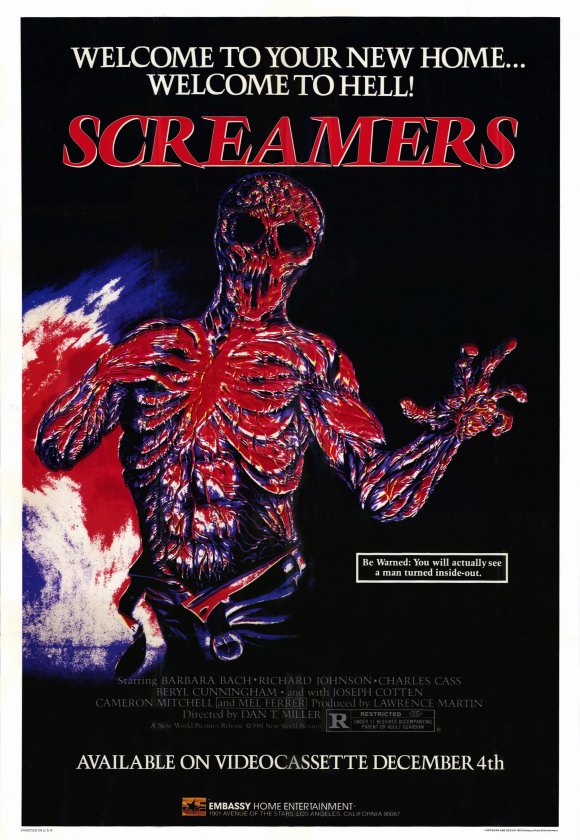
Back in the day, my dad and I would rent movies every Friday to watch on the VCR. Invariably they were horror or science fiction movies. As the '80s continued to barrel head first into the age of video, more and more choices came up. I'd seen the box for "Screamers" (no, not the Peter Weller movie of the same name, although that one's kinda bad too) several times. The image of a man who'd been turned inside out was certainly eye-catching, and so eventually I rented it, eager to see all sorts of horrific reverse-zombies.
Now... the movie starts out fine. With some folks looking for pirate treasure, only to run afoul of zombies... but then WHAT? They're kiled by a fish man? How are there fish men in my inside-out zombie movie? Turns out, the movie's NOT about inside-out zombies, but about a mad scientist who wants to turn people into fish-people slaves to loot Atlantas. Which, now that I think about it, is a pretty rockin' movie plot.
Not Pictured: Inside-out Zombies
But I was looking for those reverse zombies. And in the end, the movie itself was bad. Maybe I would have liked it better had it been advertised under it's original title, "L'isola degli uomini pesce." Or maybe if it'd not promised me inside out people.
Yeah. We need more good fish-person moives! There's a remake of "Creature From the Black Lagoon" in semi-permanent development out there at Universal, but looking at all their other reboots of their classic monster movies over the past decade or two... I'm not holding out much hope.
The concept of being lost in the woods and freezing to death is pretty scary. So is the idea of being eaten by wild animals when you're lost in the woods. What could be worse than that? How about being lost in the woods AND eaten by wild animals? Or worse than that? Being eaten by cannibals.
Now... what if you were the one lost in the woods... but YOU were the cannibal? That's pretty frightening too.
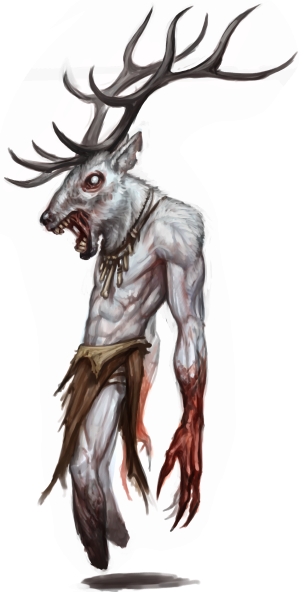
The wendigo is a monster that embodies these fears. From the original Algonquian mythology, the wendigo was described as a bloody-lipped gaunt person that reeked of death. Worse... humans could become wendigos if they were overpowered by greed.
From those myths, a number of more modern incarnations of the wendigo have evolved, but the core elements remain the same—there's something out there in the frozen woods that wants to eat you. One of Algernon Blackwood's greatest short stories is called "The Wendigo." From there, the story impressed H. P. Lovecraft and others in his writing circle, notably August Derleth, and as a result, the legend infiltrated the Cthulhu mythos in the form of the Great Old One Ithaqua. The wendigo would go on to show up in Marvel comic books, in video games, modern fiction, and of course in RPGs. I got to be the one to put the wendigo into 3rd edition D&D when for my monster assignment for the 3rd edition Fiend Folio I was asked to stat up some mythological monsters of my choice for inclusion. One of the ones I picked was the ahuizotil (a cool critter I might do in a future monster day entry), but the one I was the most proud of was the wendigo, which was a template you could put on a person or wild animal to turn him or her or it into a ravenous monster. My friend Greg Vaughan got to stat up the Pathfinder version of the wendigo for Rise of the Runelords, but I developed that adventure ("Spires of Xin-Shalast") so I got to get some work in on him there as well.
And, of course, the wendigo's been showing up more and more often in film and TV as well, with appearances in movies like Ravenous and The Last Winter and on shows like the X-Files and (according to Wikipedia) My Little Pony: Friendship is Magic.
Perhaps scariest of all, though, is the fact that, in a way, this monster's for real. "Wendigo psychosis" is a very real mental disorder that causes one to be overcome with an urge to eat human flesh when other sources of food are readily available. That's right. There could be a little bit of wendigo lurking in someone reading this blog at this very moment. Maybe... even in someone WRITING this blog!
You've come a long way, Mr. Wendigo! Don't ever change!
I ran my Serpent's Skull Pathfinder game today for the first time in several months—had to take quite a few games off due to various vacations and deadlines and the like. It was great fun, especially the point where the party's alchemist blundered into the clutches of a giant flesh-eating plant.
Which brings me to Monster #8—the killer plant.
There's something creepy about the real-world carnivorous plants like the Venus flytrap and the sundew and the pitcher plant. They're plants... they shouldn't be doing things like biting and grabbing things with glue-tipped tentacles and luring prey into what is essentially a pit full of acid. They're supposed to just grow and give us oxygen and look pretty.
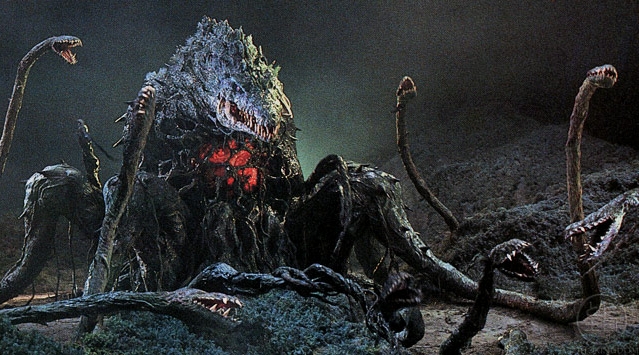
This is what happens when you use science to splice Godzilla cells into a rose.
But since so many things eat plants, I guess turnabout is fair play.
Human-eating plants don't get enough play in movies or books, I think. It's one thing to be attacked by a wild animal or even a monster, but the plants? They're supposed to be neutral parties, aren't they?
Of course, it's easy to get the killer plant story completely wrong. "Little Shop of Horrors" has a cool killer plant, but then the thing has the gall to turn into a musical. No thanks. An even GREATER affront to the genre, though, is the most recent one—"The Happening." At its core, the idea is cool—plants suddenly start producing some sort of toxin that kills people by making them commit suicide. At least... I THINK that's what the movie was about. Like so many M. Night Shyamalan movies, the longer you watch them, the less sense they make.
Fortunatley there are some good killer plant movies and stories out there that more than make up for "The Happening." My favorites are "The Ruins" and "Day of the Triffids." I actually enjoyed the movie of "The Ruins" so much that I went out and bought the novel the same day... and ended up devouring the novel in about 2 days. Super creepy stuff! In both cases (movie and novel) I think I actually like "The Ruins" better, but both stories are more or less about the same thing... the plants getting the better of us, the people.
So next time you go outside, think twice before you walk on the grass!
*This movie has EVERYTHING. Killer plants, martians, rat-bat-spiders, giant blobs... hmmmm... giant blobs... that might be a good Monster #9! **Technically, this features killer fungi, but I already kinda did that with the Mushroom People, and so the mi-go get to be featured here! ***Granted, the rapist plant in this one doesn't actually kill its victim, but she probably would have been better of if it had...
One of my favorite sub-genres (I have a lot of favorite sub-genres) of movie is the "Astronauts journey to an alien planet and explore it and encounter monsters on said planet." There haven't been many movies made with this plot lately. "Avatar" is probably the one that comes the closest most recently, but "Pitch Black" is more what I'm talking about. The height of this genre's popularity, though, was back in the '50s, it seems, with movies like "First Spaceship To Venus" and "Journey to the Seventh Planet" and, of course, my absolute favorite of all in the genre, "Angry Red Planet."
The thing I love about this movie is that, despite its low budget, it just doesn't care. It's not content with having monsters that are just people in alien suits. No siree. The monsters of "Angry Red Planet" are big, bigger, and enormous. The fact that all the Mars scenes (yes, that's the Angry Red Planet the astronauts visit) are filmed in "Cinemagic," which makes all those scenes appear all solarized and red makes the whole thing so surreal that the low budget sets actually kind of end up working in a bizarre sort of way. Of course, I'm certainly looking at it with a giant dose of nostalgia.
ANYway.
The reason I'm talking about it for Monster Day is the Rat Bat Spider.
You've seen what the thing looks like in the pictures here already, but make sure you watch the movie below. The thing is HUGE! And not only that, it's a completely freaky weird monster unlike anything I've really ever seen in movies before or since. Heck... it's got enormous pincers, so the fact that the Internet calls it a Rat Bat Spider isn't even right... it should be a Rat Bat Spider Crab. Except that it's the size of a house.
Man... this is one movie that someone needs to remake JUST for ME.
I'm not an arachnophobe, but I can certainly understand why so many people are. Spiders are scary. I don't freak out if I see one in my house, but having one show up unexpectedly can still be startling. Especially if it's a black widow or something equally instantly recognizable as something that can put me in the hospital. But for the most part, I quite like spiders; they eat ants and flies and other pests that I'm much more frustrated with, and actually most of them are quite graceful and beautiful in their lovely alien ways.
But certainly, the bigger a spider gets, the more intimidating they become. Like the one we found at Paizo one day a few years ago, crawling around on the floor in front of Jason Bulmahn's office—that one was a beast! See the video for proof—that's Sean K Reynolds holding the spider up for me to catch all its glory with my iPhone. We let the big guy loose in the grass out behind the building once his 15 minutes of fame were up... and since we couldn't be sure it wasn't a hobo spider, we made damn sure not to let him bite us. Of course, when a spider gets to be big enough, it doesn't matter if it's poisonous. It hurts to be bitten by something with visible fangs.
There's a fair number of movies about spiders out there, small and large. Most of them aren't all that good, but fortunately for spider fans like me, there's lots of them, and that means the total number of giant spider movies that are good increase. My absolute FAVORITE giant spider movie of all time, and indeed one of my favorite movies of all time, is Tarantula, a movie from the mid-50s about a mad scientist who is trying to build a new type of radioactive chemical that causes animals to grow to enormous sizes. He hopes to solve the world hunger problem by, essentially, increasing rabbits and guinea pigs and other smaller creatures up to cow size, giving us all an unlimited amount of food to eat. In typical charming 50s style, the repercussions of eating meat grown via the introduction of radioactive super-science are more or less completely glossed over.
The repercussions of what happens if a lab tarantula gets dosed with the stuff, on the other hand, are NOT glossed over. The movie uses a real tarantula for the bulk of the scenes, superimposed into barren southwestern deserts or set free on well-built models with double-exposed victims running in fear or attempting in vain to explode the spider with dynamite. They used tiny blasts of compressed air to guide the spider along the route through these sets, and the result looks really good, even today. Now and then, for the tarantula's close-ups, they use a puppet that's really pretty frightening and effective looking. In the end, they have to essentially call in Clint Eastwood to save the day. No joke! This movie's one of his first roles, with a cameo as a jet fighter pilot—you can only see his eyes and hear his voice, but since it's Clint, that's all that you need!
For example, the Fouke Monster, known perhaps more widely as the Boggy Creek Monster, has only three toes. That's pretty unusual, especially considering pretty much no other big hairy hominid prints have three toes. Could this mean the Fouke Monster is a mutant? Or is the one that terrorized the people of Fouke, Arkansaas back in the early 70s merely deformed? Or, perish the thought, are the Fouke Monster tracks the work of a hoaxer who didn't do his homework on basic Bigfoot (and basic primate) zoology?
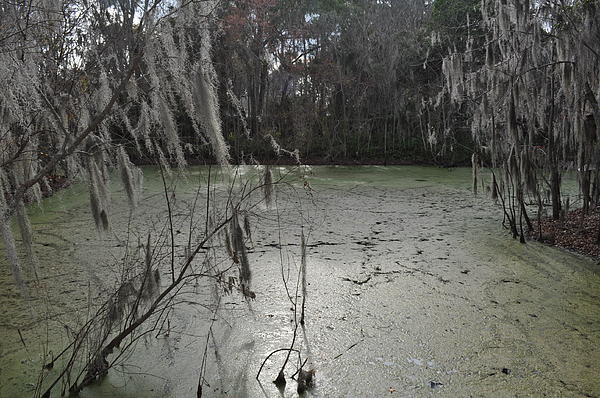
In the end, it doesn't matter, because the Fouke Monster is the scariest of the Bigfoots. Partially because it lives in a swamp, arguably the scariest of all terrains. Partially because stories about encounters with the Fouke Monster tend to be a lot more agressive that most Bigfoot encounters are. But when you get right down to it, the reason it's scary is because of "The Legend of Boggy Creek."
This movie was more than just a drive-in feature that achieved unexpected popularity and success (7th most successful movie of 1972 in fact... also the year I was born!). It seems like it spawned an entire generation of cryptozoologists. It certainly did a number on myself and my sister, back in the late 70s when it showed up on TV now and then. I once convinced my younger sister to stay up until midnight to watch the movie, and she made it barely through the credits. The combination of the forlorn cries of a loon, the raspy croaking of bullfrogs, the swampy visuals, and then the eerie sound of a monster howling somewhere in that swamp as a young child appears to run for his life from an unseen terror were too much. She went to bed before the credits rolled.
If you name a place like this "Boggy Creek," why NOT have a monster in it?
I did not. I watched the whole movie. I've been having nightmares about Bigfoot peering through a bedroom window (one that's at least 7 feet of the ground, mind you) ever since.
The tradition of watching monster-flavored entertainment on the television was not limited to "Creature Features" while I was growing up. Other TV shows like "The Twilight Zone," "Star Trek," "Space: 1999," and so on were regular viewing as well. One of those shows was "Tales from the Darkside," and while this Sunday's monster originally came from a short story by Michael Bishop (a story and an author unread by me, but who, according to Wikipedia, has a pretty impressive resume), it was from the adaptation of "Seasons of Belief" that I first learned of the Grither.
Out of context... this is even scarier!
In the story, a precocious child makes clear that there's no such thing as Santa Claus. Her parents, not to be outdone, proceed to tell their kids the story of the Grither... a supernatural creature with huge ears, giant arms, and who's as tall as a poplar tree—a creature whose pale skin lets the veins and arteries show though giving him the appearance of a road map, only the blue and red of his veins and arteries allow for the transport of fear and wrath rather than traffic.
I could go on... but as it turns out, the entire episode of "Season of Belief" is on You Tube. Check it out, and I defy you to not be singing the Grither song at some point thereafter! Just make sure to skip saying his name!
Reccomended Viewing
"Seasons of Belief," from Tales from the Darkside (see You Tube links below)

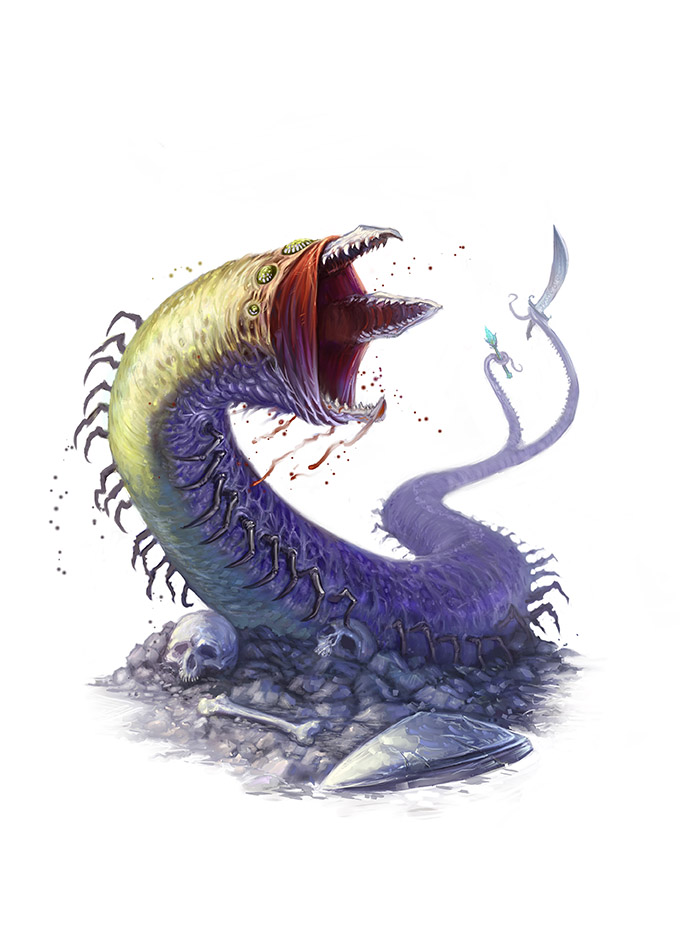 Giant Worms are even in the same movie I mentioned last week—Peter Jackson's remake of King Kong. And elsewhere as well. Heck... I guess I don't have much more to say about giant worms, but the list below is pretty big nonetheless...